
Nebraska City Directory Collections
For local research, the clearest starting point is the Omaha Public Library (OPL) collection, which brings together city directory runs from towns across Nebraska. Nebraska year runs are not continuous in every place, and the Omaha shelf is much fuller than selections for smaller communities. Use the table as a map of the collection holdings, then confirm the exact edition and format with the holding library before planning a visit or request.
| Collection | Years | Where Held | Access |
|---|---|---|---|
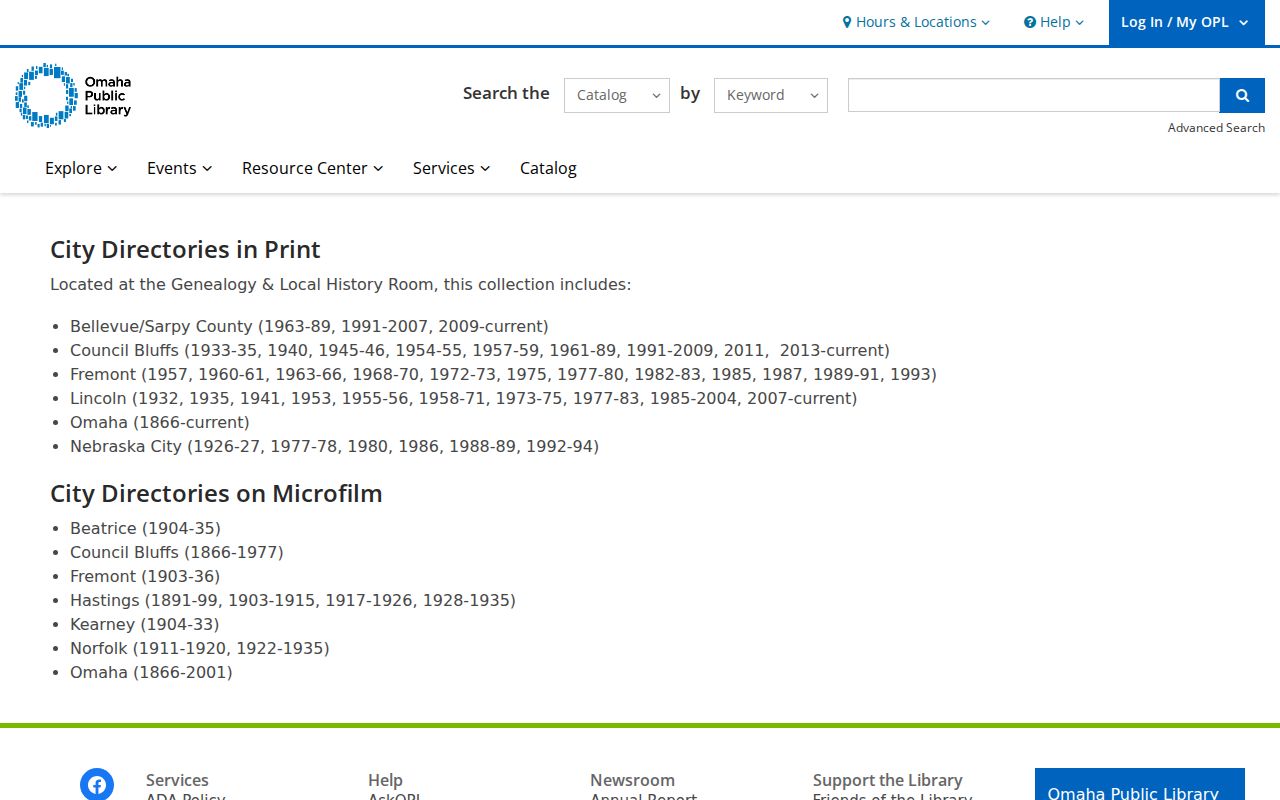
| Omaha, Nebraska directory volumes | Print, 1866 to current; microfilm, 1866-2001 | OPL Genealogy & Local History Room, Omaha | For Nebraska editions, check the annual title page and key. |
| Lincoln, Nebraska directory volumes | Lincoln Libraries reports 1876 to current, with missing 1940s years; OPL holds selected years: 1932, 1935, 1941, 1953, 1955-56, 1958-71, 1973-75, 1977-83, 1985-2004, 2007 to current | Lincoln City Libraries Heritage Room; OPL selected print holdings | Ask which year and format is on site; a long range includes gaps. |
| Bellevue and Sarpy County, Nebraska | 1963-89, 1991-2007, 2009 to current | OPL print collection | Keep metro coverage separate from Omaha and Douglas County. |
| Fremont, Nebraska | Microfilm 1903-36; print 1957, 1960-61, 1963-66, 1968-70, 1972-73, 1975, 1977-80, 1982-83, 1985, 1987, 1989-91, 1993 | OPL Genealogy & Local History Room | Large gap between early film and later print selections. |
| Beatrice, Hastings, Kearney, Norfolk, Nebraska | Beatrice 1904-35; Hastings 1891-99, 1903-15, 1917-26, 1928-35; Kearney 1904-33; Norfolk 1911-20, 1922-35 | OPL microfilm room | Year gaps vary by town; pair a hit with local sources. |
| Nebraska City and Council Bluffs | Nebraska City print: 1926-27, 1977-78, 1980, 1986, 1988-89, 1992-94; Council Bluffs print: 1933-35, 1940, 1945-46, 1954-55, 1957-59, 1961-89, 1991-2009, 2011, 2013-current; microfilm 1866-1977 | OPL print and microfilm; Otoe County Museum context for Nebraska City | Council Bluffs is across the Missouri River in Iowa. |
| Nebraska Gazetteer and Business Directory | 1879-1917, in selected digitized rolls | FamilySearch catalog; History Nebraska Gazetteer Index for 1890 and 1911 | Useful statewide context where a town directory is absent. |
| Omaha, Nebraska telephone books | 1920 to current, as reported by OPL | OPL Nebraska Reference Collection | A later address clue, not a full resident list; some numbers are unlisted. |
The table records Nebraska runs documented by OPL, not a promise that every place had a directory every year. A missing volume means that the listed collection has a gap; another repository in the state may hold a copy. Lincoln Libraries describes a broader 1876-to-current Lincoln run, while OPL’s listed holdings show selected dates. Check the Nebraska library catalog for the room you plan to use.
Note: OPL’s year list describes its own holdings; a library in the town being researched may preserve other editions or formats.
Omaha City Directory Holdings
OPL’s Genealogy & Local History Room is the most fully described municipal directory room identified for Nebraska. It holds Omaha print volumes from 1866 to current and microfilm from 1866 through 2001, alongside runs for other cities. The collection page names available years by place, which makes it a practical first check when an ancestor’s town is known but the year is not.
For a look at OPL’s directory and local-history holdings, start at its city directory collection page, which names local runs by place and year.
OPL also has a microfilm room with census reels, Nebraska newspapers, church records, county marriage material, naturalization indexes, cemetery sources, and vital-record holdings. These collections can add a second date or relationship clue when a directory entry alone is thin.
OPL’s local-history FAQ describes obituary-search help and an address/homeowner index in progress. It also reports that Omaha building files spanning the 1880s through the 2000s were discarded by a former city building inspector. An old directory may help bridge an address, but it cannot restore a lost permit file or prove who occupied a home.
For local-history routes, use OPL’s microfilm room information and genealogy and local-history help before requesting a reel or obituary search.
Room access is not limited to a web catalog. Ask library staff about print volumes, microfilm readers, whether a reel can be scanned to a flash drive or printed, and whether a licensed database is available in the room. OPL reports four readers that scan to flash drive and two that print ledger-sized images; the Nebraska Reference Collection is closed-stack, so request an item through the desk.
Nebraska City Directory Runs Outside Omaha
Smaller Nebraska town runs call for a more careful search by place and year. OPL’s Fremont collection combines 1903-36 microfilm with selected print years from 1957 through 1993. Hastings has microfilm in four blocks, 1891-99, 1903-15, 1917-26, and 1928-35. Kearney’s run covers 1904-33, while Norfolk’s covers 1911-20 and 1922-35. Those gaps are a cue to switch sources for missing years, not to assume that a household left town.
OPL’s Nebraska City print copies are scattered across 1926-27, 1977-78, 1980, 1986, 1988-89, and 1992-94. The Otoe County Museum and the Nebraska City History Harvest may add oral histories and documents, while county records and local newspapers can bridge a directory gap. Beatrice’s 1904-35 film can help with early twentieth-century address work, but another local source is needed for later years.
The Bellevue and Sarpy County, Nebraska run is distinct from Omaha’s: OPL lists 1963-89, 1991-2007, and 2009 to current. Council Bluffs listings can also matter for a Nebraska family that crossed the Missouri River, but they describe an Iowa place. Keep the state and county attached to each note so a nearby address is not mistaken for a record from the wrong state.
Note: A town’s listed run may skip annual editions, so check nearby repository catalogs before treating a gap as a move.
Reading a Nebraska City Directory Entry
A Nebraska directory volume is an annual printed source, not a sworn statement that every listed person slept at an address. FamilySearch describes names on residential lists and business listings; its records may include a name, occupation, and address. Spouse marks, owner or renter clues, and short forms depend on the publisher and edition. Use the field checklist to verify details on the actual page image; it is not a transcription of one sample person.
| Alphabetical entry | Look for a Nebraska resident’s surname, given name or initials, and any cross-reference spelling printed by that edition. |
|---|---|
| Occupation or business | Record the occupation and associated business when shown; these details can help tell two Nebraska people with the same name apart. |
| Address | Copy the Nebraska street number and name as printed, including an apartment, room, or abbreviation. |
| Household notation | Check the volume for a spouse in parentheses, a widow notation, or another relationship mark. |
| Owner or renter mark | Use the edition’s symbol only if its abbreviation key defines it; conventions vary by publisher and year. |
| Reverse listing | In a street-order section, record the Nebraska occupant or householder and any business use shown beside the address. |
| Key and symbols | Use the publisher's own front-matter key before reading marks such as “h,” “r,” or “wid.” |
- Criss-cross directory
- A Nebraska directory section arranged by street and number rather than only by a person’s name.
- Householder index
- A route into a listed person or Nebraska household; the exact order and included fields vary by book.
- Abbreviation key
- The publisher’s guide to marks and short forms, usually in the front matter; read it before expanding a Nebraska entry.
Do not expand an “r,” “h,” or “wid” mark from memory. A key can show how that publisher used the term, and the next Nebraska year may use another convention. Copy the symbol and page number into research notes before interpreting it.
Search Nebraska City Directories Online
For Nebraska researchers, FamilySearch’s United States, City and Business Directories collection covers material dated about 1749-1990. Its Nebraska index is only one route into a volume. Results can vary by image rights, and a typed field may not reproduce a Nebraska page exactly.
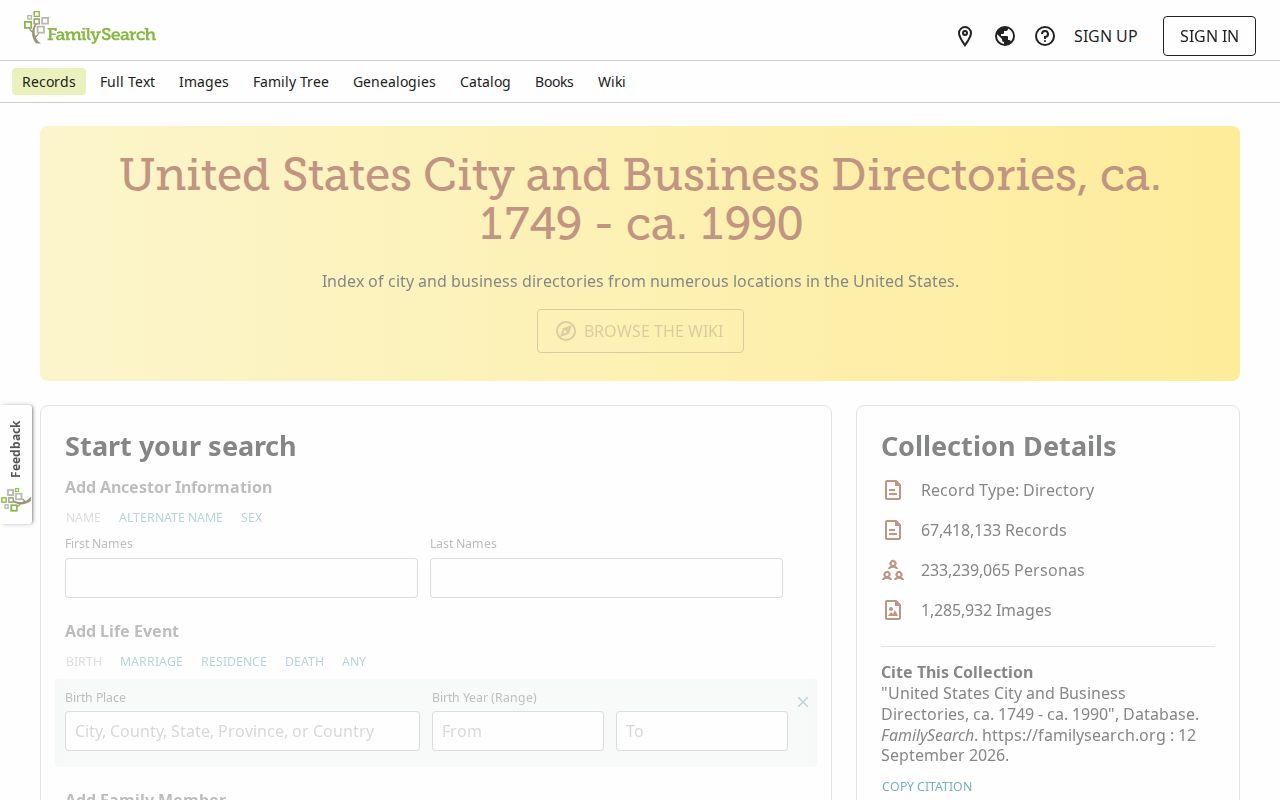
For a Nebraska search, FamilySearch offers first and last name, alternate name, sex, birth place and year, residence, spouse, father, mother, another family member, keyword, location, record type, batch, film or image-group number, and principal. Its keyword help allows a Nebraska street address, religion, occupation, place or person name, and marital status. Use one or two fields at a time; an exact Nebraska place spelling or family name may be indexed differently from the printed page.
| Search field | What to enter | How to use it |
|---|---|---|
| Name and alternate name | Nebraska resident’s first name, last name, or a known spelling variant | Try initials, married names, and alternate spellings as separate Nebraska searches. |
| Residence and location | Nebraska town, place, or a known street address | Narrow to the Nebraska place, then compare the result with the Nebraska book image. |
| Family members | Nebraska spouse, parent, or another family member | Use a second Nebraska household name to distinguish a same-name entry. |
| Keyword | Nebraska address, occupation, religion, name, place, or marital status | Search a phrase tied to the specific Nebraska volume; indexing may be incomplete. |
| Collection controls | Record type, batch number, film/fiche/image-group number, principal | Use when a catalog or earlier reference supplies the identifier. |
Open the linked Nebraska image when available, then compare its title page and abbreviation key with the index. Image availability varies by rights. A result without an image is still a lead to the Nebraska print or microfilm run.
Note: A Nebraska index hit points to a possible entry; check the scanned page and its edition key before copying a detail into family notes.
Nebraska Gazetteers When City Runs Are Missing
For a small Nebraska place without a surviving city directory, a gazetteer can supply a different kind of context. FamilySearch’s Nebraska Gazetteer and Business Directory catalog lists digitized rolls dated 1879-1917, including image groups 107726701 through 107726710. Its entries support research on Nebraska towns, farmers, and businesses rather than a complete list of every Nebraska resident.
Use the Nebraska Gazetteer catalog to identify a Nebraska roll, then follow its image-group controls. Access may require a FamilySearch sign-in or an affiliate center. History Nebraska also lists Nebraska Gazetteer Index volumes for 1890 and 1911. Keep the catalog title and Nebraska image-group number with the note, because a catalog record points to material but does not guarantee that every image is open from home.
A Nebraska gazetteer can help confirm that a town, post office, or business name existed in a given period. It does not replace a Nebraska household listing. Pair it with county histories, maps, newspaper notices, deeds, probate, cemetery records, or a directory from the nearest larger town when the question concerns one Nebraska family.
Trace a Nebraska Household Across Directory Years
A former Nebraska classmate or relative may appear under a changed surname, initials, or a different town name. A careful sequence gives each Nebraska entry a date and a place, then checks it against a source made for another purpose. That matters in Nebraska, where directories, census schedules, and local newspaper runs do not cover the same years.
- Start with the exact Nebraska town and the person’s known name. Search a Nebraska alphabetical section, then check alternate spellings or a spouse’s name.
- Write down the Nebraska edition year, publisher, name as printed, occupation, address, and household marks. Keep the Nebraska page or image reference with the note.
- Follow the Nebraska address through the reverse section when the volume has one. A street listing may reveal a change even when a name index is hard to read.
- Compare Nebraska directory entries around census years. The latest released federal population schedules run through 1950 under the 72-year release rule; a census gives a decennial household snapshot, while a directory may fill some intervening years.
- Check a second Nebraska record, such as an obituary, cemetery entry, newspaper notice, deed, or probate file, before treating a match as the same person.
A Nebraska name that disappears could mean a move, a death, a missed volume, an unlisted household, or an index spelling that does not match the family’s form. It is not proof that the person left Nebraska. A Nebraska classmate trail can combine yearbooks, directories, obituaries, and library archives, but a compiled profile alone cannot settle identity.
For a Nebraska name, try maiden and married names, initials, hyphens, anglicized forms, ethnic-language spellings, and abbreviations as separate variants. Nebraska’s history guides include Czech, German, Black and African American, church, and military research material, which can help when an English index form differs from a family source.
Nebraska’s record geography adds another layer. Territorial Nebraska boundaries shifted, Nebraska counties were renamed or dissolved, and a present-day Nebraska town may not be the place name used in an older source. History Nebraska describes territorial “ghost counties” that arose from map or publishing errors and were later corrected through archival research.
- 1854: Nebraska became a U.S. territory.
- 1861: Forty counties had been created, after an initial set of eight territorial counties; some names and boundaries later changed.
- 1866-1876: OPL’s Omaha directories begin in 1866; Lincoln’s directory history reaches back to 1876.
- 1878-1883: History Nebraska was founded in 1878 and began receiving legislative funding in 1883.
- 1879 onward: Gazetteers add another reference layer, with digitized rolls extending through 1917.
Nebraska City Directory Research Beyond Catalogs
When a Nebraska web index ends, contact the repository that holds the book or reel. History Nebraska’s Potter Research Room at 1500 R Street in Lincoln holds Nebraska maps, newspapers, manuscripts, photographs, government records, and reference material. It is open Wednesday through Friday from 9 a.m. to 4 p.m., with Monday visits by appointment. Nebraska reference staff can be reached at 402-471-4751 or reference@hn.libanswers.com to help identify a finding aid or explain whether a record is available as an image, microfilm, or in person.
Start with History Nebraska’s research and reference services, and search its collections catalog and finding aids for a Nebraska town, family, or organization. A Nebraska finding aid describes a collection; it does not mean every item is digitized. For a request, note the collection title, series, box or folder, and the repository, then ask about a Nebraska appointment, scan, or reference lookup.
OPL’s closed-stack Nebraska Reference Collection can add Nebraska town and county histories, maps, gazetteers, yearbooks, church or parish histories, cemetery records, periodicals, and vertical files. Nebraska county historical societies may hold a school register, plat book, oral history, or family paper that has no statewide online index. Call or email before traveling to confirm hours, copying rules, and which Nebraska volumes are on site.
The Douglas County Historical Society’s Nebraska research-services inventory lists Omaha volumes for 1866-1891 and 1900 to current, plus microfilm directories for 1874-1942. It also lists Omaha and South Omaha birth/death registers, Nebraska county marriage indexes, and naturalization records. Its current notice says research requests are on hold, so use the collection inventory and contact route without assuming immediate lookup service.
Once an old directory points to a present street, address-keyed current records follow a different path; the Nebraska street directory explains that parcel and street workflow. To confirm a living person across current official sources, continue with the Nebraska resident lookup approach rather than treating an old listing as current proof.