
Nebraska Previous Residents by Era
A Nebraska address can leave a different trace in each era. An assessor card is a current parcel snapshot, a deed records a transfer of an interest, and an annual directory may place a household at a street number. The table keeps those jobs separate. When tracing previous residents, treat each date span as a local collection fact. Coverage belongs to a county, town, or collection, so the years below are useful examples rather than one statewide promise. The representative towns are Nebraska collections, not one shared statewide series.
| Source | Years It Covers | Where Held | What It Shows |
|---|---|---|---|
| Nebraska county deed books and indexes | County-specific; Knox County, Nebraska, describes records from the 1850s to present | Nebraska Registers of Deeds, courthouse books, county portals, or FamilySearch | Nebraska recorded transfers, liens, mortgages, plats, and legal descriptions |
| Omaha, Nebraska directories | Omaha, Nebraska print 1866-current; microfilm 1866-2001 | Omaha Public Library's Nebraska Genealogy & Local History Room | Nebraska annual resident names, addresses, and occupations |
| Lincoln, Nebraska directories | Nebraska library series from 1876-current, with some 1940s gaps | Lincoln and Omaha Public Library Nebraska holdings | Nebraska households and street entries in surviving years |
| Other Nebraska town directories | Nebraska examples include Hastings 1891-1935 in broken runs, Kearney 1904-1933, and Norfolk 1911-1935 in segments | OPL's Nebraska print or microfilm holdings; some local and UNL collections | Past residents of Nebraska towns where a volume survives |
| Nebraska federal census | Nebraska population schedules begin in 1860; public schedules through 1950 | Nebraska access through Census/NARA, FamilySearch, OPL, and History Nebraska | Nebraska household members and an enumerated address at a ten-year point |
| Lincoln, Nebraska occupancy permits | Lincoln, Nebraska legacy public search: 05/01/1999-01/18/2013; newer permits use Accela | City of Lincoln, Nebraska permit search and Citizen Access | Nebraska permit, inspection, applicant, contractor, and address details when retained |
| Omaha, Nebraska Sanborn maps | Nebraska example volume for Omaha/Douglas/Sarpy, 1918-1962 | Nebraska map sheets at the Library of Congress and local libraries | Nebraska building shape, material, use, and dated street context |
| Nebraska newspapers and notices | Nebraska territorial-era titles to present, depending on title and surviving run | History Nebraska, OPL, Nebraska Newspapers, and libraries across Nebraska | Nebraska deaths, moves, probate notices, building news, and address clues |
For a recent ownership question in Nebraska, begin with the county parcel and deed records. For an older household, start with the nearest surviving reverse directory and census year, then use Nebraska maps and newspapers to test the match. A missing Nebraska volume marks a gap in the record trail, not proof that no one lived there.
Nebraska Past Residents and Deed Cutoffs
Nebraska has 93 counties, each with its own Register of Deeds or, in some counties, a county clerk who serves in that role. Start by choosing the Nebraska county that holds the parcel. The Nebraska Department of Revenue county directory routes readers to assessor and parcel contacts. The statewide Nebraska Deeds Online landing page is another route to Nebraska land records, but it does not create one uniform index for all 93 counties. A Nebraska deed search must still be routed to the county custodian.
Online reach is not the same as the life of a Nebraska county record. Platte County's Register of Deeds page states that its online images and data begin February 1, 2005; this is Platte County, Nebraska coverage, not a state cutoff. Lincoln County, Nebraska, says instruments recorded after March 2000 use instrument numbers, while earlier Nebraska records use book and page references. Knox County's Register of Deeds page describes Nebraska recorded documents from the 1850s onward, but a county's stated record span does not mean every old image is online. A Nebraska search result may be an index entry without an open image. Previous residents may therefore require a Nebraska courthouse book or microfilm even when the county has a web search.
The Lincoln County Register of Deeds page describes a Nebraska genealogy search, computer-generated grantor/grantee indexes, microfilm, and scans. The image below is a Lincoln County, Nebraska example of the office's deed-search route. It is not a statewide control panel, and the correct Nebraska county must still be selected for the address in question.
Nebraska county index fields are not identical, but the common deed-search and result labels below help compare county systems. Capture each available item before moving to a Nebraska book, counter, or copy request.
| Search or record field | Type or use | What to note |
|---|---|---|
| Nebraska grantor | Name search | Nebraska seller or transferor spelling and order as indexed |
| Nebraska grantee | Name search | Nebraska buyer or recipient; check other name forms when known |
| Nebraska legal description | Text or browse | Lot, block, subdivision, section-township-range, or other Nebraska parcel wording |
| Nebraska instrument or document number | County-specific identifier | Nebraska number format and whether older records instead use a book/page |
| Nebraska book and page | Older-record reference | Volume and page needed to reach a Nebraska courthouse book or microfilm |
| Nebraska date range and document type | Portal-dependent filters | County-specific Nebraska date controls and deed, mortgage, lien, release, or plat category |
| Nebraska recording date and image access | Result details | Recorded date, available Nebraska image or copy route, and any stated access limit |
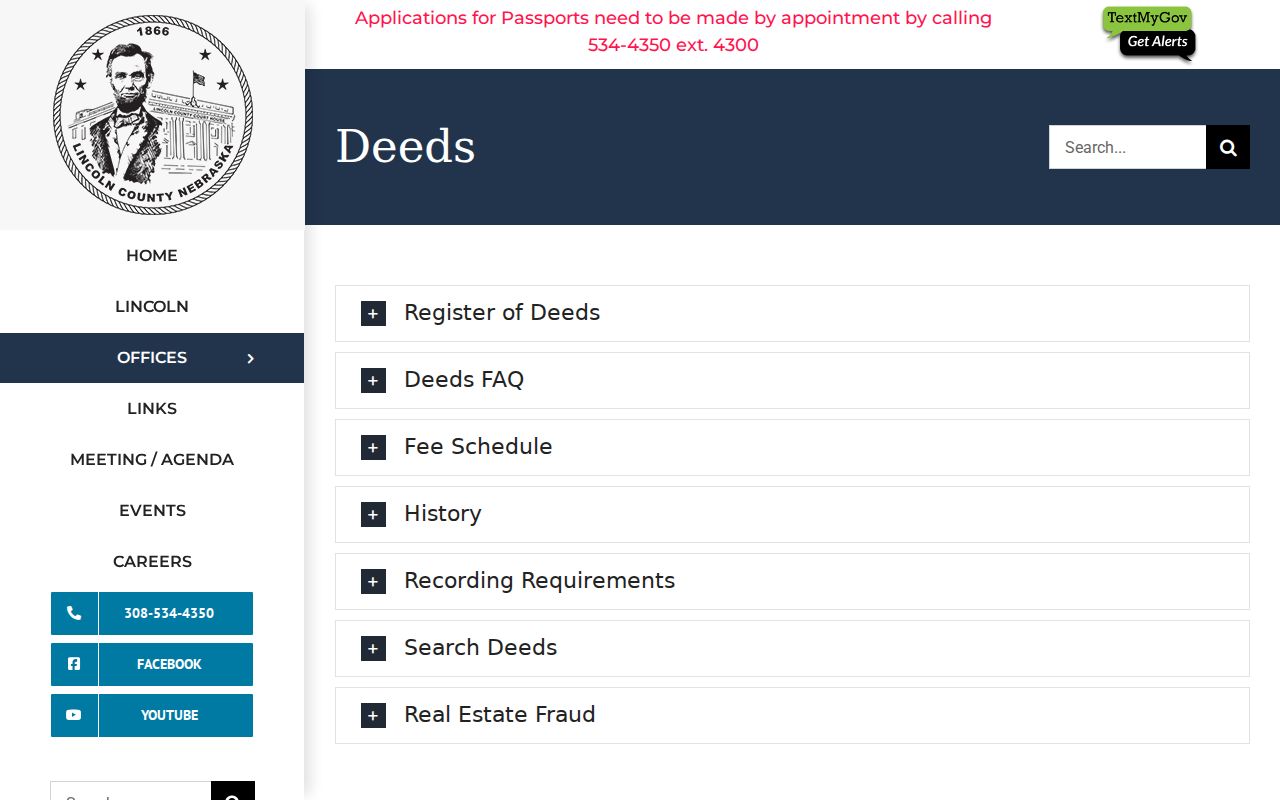
For an earlier Nebraska deed, note whether the county points to a courthouse book, microfilm reader, paid database, or copy request. Save the Nebraska index terms and record number before leaving the website, so a clerk or librarian can follow the same trail.
Trace Nebraska Deed Ownership Backward
The deed chain connects recorded parcel transfers, not every person who occupied a house. Begin with the current parcel card, then use the legal description to separate it from a nearby lot with a similar street number. In Nebraska, county vendor fields and image access differ, so keep the county and the source date beside each result.
- Open the Nebraska county assessor or GIS route from the Department of Revenue directory. Record the current owner, account or parcel number, situs address, mailing address, and full legal description.
- Search the Nebraska county Register of Deeds index for the current owner as grantee. Use the legal description or parcel clue to tell the right person and parcel from a same-name result.
- Write down the deed's grantor, grantee, recording date, instrument number or book/page, and legal description. Confirm that it is a deed, not a mortgage, release, lien, or plat.
- Search the prior grantor as grantee for the same legal description. Repeat the transfer backward until the online index ends or the parcel description changes.
- At the cutoff, ask the Nebraska county office about its books, microfilm, terminal, copy process, or archive referral. Compare each older link with a Nebraska plat, directory, tax entry, or probate record.
- Grantor / grantee
- The grantor gives or transfers the recorded interest; the grantee receives it.
- Chain of title
- The sequence of recorded interests and transfers tied to one parcel. It may not name each household member.
- Legal description
- The lot, block, subdivision, section-township-range, or boundary wording that identifies land beyond a modern street address.
Nebraska's property trail often shifts from a street address to an older lot or section description. Previous residents who appear in an index are tied to a recorded interest, not necessarily everyone who used the building. Keep the original wording instead of translating it from memory, and ask the county office when a scan is unclear.
Nebraska Previous Residents and Old Streets
Modern addresses do not always line up with the labels on an older Nebraska deed, plat, or directory. Omaha grew across section lines and annexations; the present road network includes routes that began as older trails or survey lines. History Nebraska's account of an 1857 map notes that Military Avenue follows part of an earlier Mormon and military road, while today's 144th Street overlays older route geography. A house may sit in nearly the same place while the name used to find it has changed.
County history can matter too. Nebraska's territorial and early state county map changed over time, including counties later renamed or reorganized. A deed or newspaper may name an older county, township, post office, or land district instead of the modern city. For a rural place, the legal description may be more durable than a mailing address that came later. Preserve those older place names and search them as written before deciding a record is missing.
When an address fails, compare the subdivision and lot/block, a plat map, a dated Sanborn sheet, directory street sections, and present parcel data. This is a Nebraska geography problem, not a reason to force a close-looking address match.
Nebraska Past Residents on Historic Maps
History Nebraska's 2010 guide, A Place in History: Researching Your Nebraska Property, lays out a house-history method using directories, maps, deeds, and related records. It recommends leapfrogging backward or forward in five-year steps, then filling the important years around a move or building change. Its advice is useful statewide, but every county and town still has its own surviving record run.
Sanborn fire-insurance maps help date the physical setting. The Library of Congress Omaha/Douglas/Sarpy volume covers 1918-1962 with 54 sheets, while other Nebraska towns have separate items. A sheet can show a building footprint, material, use, and street context on the date represented. It does not name the owner or prove who lived inside, so pair it with a deed or directory entry.
Map evidence is strongest when each record is labeled with its date and purpose. A plat can explain a lot boundary, a Sanborn page can describe a structure, and the assessor map can show the present parcel. None should be treated as a substitute for the others.
Pair Nebraska Directories With Census Years
Directories bridge the years between census counts. Omaha Public Library's Omaha run begins in 1866, with print volumes to the present and microfilm through 2001; Lincoln City Libraries reports a run from 1876 to the present with some unavailable 1940s years. OPL also holds segmented runs for places such as Fremont, Hastings, Kearney, Norfolk, and Beatrice. The exact title and gaps matter more than a broad claim that a town has directories. The OPL directory collection list shows which runs are held. A deeper explanation of those books belongs on the Nebraska city directory page.
- Write down the full Nebraska address, town, and any old street form before searching a directory.
- Use the Nebraska reverse or street section when present to locate a number, then check the alphabetical entry for the name, occupation, and household notation.
- Record the year, publisher, spelling, street number, and abbreviation key. Do not assume a mark has the same meaning in each annual volume.
- Compare an available directory year with the nearest census schedule. The census can list a household at a ten-year point, while a directory may supply interim address or occupation evidence.
- Check a second source, such as a Nebraska deed, plat, newspaper notice, obituary, or probate file, before treating a likely match as certain.
The latest federal population schedules open to the public in 2026 are from 1950 under the 72-year release rule; Nebraska's first federal census was in 1860. Directory years after the public census window can still offer address clues, but they do not replace a private person's consent or a record held by the proper custodian.
Nebraska Past Residents and Permit Gaps
Building and occupancy files can help date a change to a house, though they record work or inspection events rather than a full resident list. Lincoln's legacy occupancy search covers May 1, 1999 through January 18, 2013; newer permit searches run through Accela Citizen Access and accept an address, parcel, or permit number. Omaha has a known gap because a large run of old building records was discarded. A missing permit record therefore cannot establish that a building was empty or unchanged.
Try the Nebraska city or county building office's online search first, then ask the department about retained paper records and request options. For a Nebraska address outside a city with a portal, the county assessor's improvement data, dated maps, and newspapers may be the practical leads. The permit applicant or contractor is not automatically the owner or occupant.
Keep the record's role clear: permits date work, maps describe a place, and deeds record transfers. The strongest house history comes from matching those independent records by parcel, date, and place name.
Nebraska Past Residents in Probate
When a former owner died, an obituary can offer a date, relatives, a town, and sometimes a last address. Probate may then explain who handled the estate or how an interest passed to an heir. History Nebraska and Omaha Public Library preserve newspapers and historical collections; their catalogs and microfilm readers are useful when an online index gives only a name or short notice. Omaha Public Library offers microfilm readers that can scan pages to a flash drive or print them.
For older Nebraska research, use a layered request path: search the Nebraska county portal, call the county assessor or Register of Deeds using the state county directory, and visit the courthouse counter or public terminal if needed. If a record is not posted, a written request under the Nebraska Public Records Statutes, Neb. Rev. Stat. §84-712(4) should identify the record, parcel or legal description, and date range. The custodian must provide access, a denial, or an explanation of delay and estimated cost as soon as practicable and no later than four business days. Copy charges are limited to actual added cost. Ask the library or local historical society about its microfilm, books, scans, and appointment rules; History Nebraska's Potter Research Room lists hours and reference contacts online. Omaha Public Library's Microfilm Room provides readers that can scan pages to a flash drive or print them.
Use a directory find or obituary as a lead, not proof that a living person remains at an address. Previous residents research can support family and property history while leaving unnecessary private details out of public copy.
Use records with care. Public access does not make it acceptable to track, threaten, or expose a living person. Nebraska's official domestic- and sexual-violence program warns that stalking can involve obtaining personal information through public records; keep a search focused on lawful house, family, or property history.